In Bright Leadership Reflections we ask leaders who help shape what comes next to pause on what leadership truly asks of us today. Their choices, their insights, their doubts. This time, we spoke with Marion van Happen.
What is the essence of leadership talent for you, and how do you recognise it immediately?
I do not recognise leadership talent by how loudly someone speaks, but by what happens around that person. The essence is the ability to give direction and leave space. I see it in leaders who can paint a picture of the future that moves people, and at the same time make sharp decisions today to make that future possible.
They combine vision with execution, edge with humanity. You recognise it in teams that grow, take ownership and feel proud of what they build together. It is not the leader's ego that grows, but the strength of the collective. That is where the real impact sits.
Leadership is choosing a direction and creating space at the same time, so people can learn, discover and make impact.
Which leadership challenge should leaders truly prepare for in the coming years?
The biggest challenge is leading in permanent uncertainty. AI, geopolitics, labour-market scarcity and societal pressure mean the playing field changes constantly. Leaders need to learn to steer without having all the answers.
What becomes decisive is no longer control, but meaning, agility and a moral compass. It is about offering safety while everything moves, and making decisions with incomplete information. That takes guts, responsibility and integrity. And the awareness that leadership is not only about today, but about what you make possible for tomorrow.
What should leaders stop doing, because it no longer works?
Pretending they know everything. Steering top-down without dialogue. And confusing busyness with impact. We also need to stop optimising the past when the future is asking for something entirely different.
Today, leadership asks for vulnerability, listening, and letting go of old certainties. Not getting stronger through control, but through trust. Whoever wants to hold on to everything, ends up holding no one up.
Which leadership decision made you and your team visibly stronger?
The decision to invest radically in trust and ownership. Not locking everything down, but making people truly accountable for results and actively supporting them in that. It made our teams faster, more innovative, more resilient.
We grew from a classic organisation into an ecosystem where technology, data and people create new value together. To me, that is paying it forward: building structures in which others can grow, even when you yourself take a step back.
Which trait in other leaders genuinely gives you energy?
Authenticity, courage and curiosity. Leaders who do not put themselves at the centre, but the intent. Who embrace difference, dare to have the uncomfortable conversation, and use technology to become more human, not more distant.
I get energy from leaders who connect head and heart, and understand that their success does not sit in personal visibility, but in how many others they enable to grow.
Which way of leading costs you energy?
Micromanagement and political behaviour. When power becomes more important than impact, and position more important than purpose. That suffocates creativity and slows down change.
Organisations today need leaders who create space rather than build walls. Leaders who help others move forward, and so enable acceleration and creation, especially in times of uncertainty.
Which leadership quality is structurally underestimated?
Moral courage. The courage to do what is right, even when it is not popular. To be transparent when things get tense. The courage, too, to make short-term gain subordinate to long-term value for people, customers and society.
That asks for leaders who look beyond their own term or position, and take responsibility for what they pass on to the next generation.
Which insight about people do you wish you had understood ten years earlier?
That people do not resist change. They resist loss. Loss of certainty. Loss of identity. Loss of meaning.
Once you understand that, your leadership changes fundamentally: from convincing to understanding, from pushing to inviting, from making plans to building together. Then leadership becomes something you pass on, not something you own.
Bright Leadership in your words?
Leadership is not a position. It is the courage to give direction, leave space, and take responsibility for the future we want to build together. Even when we ourselves are no longer at the centre of it.
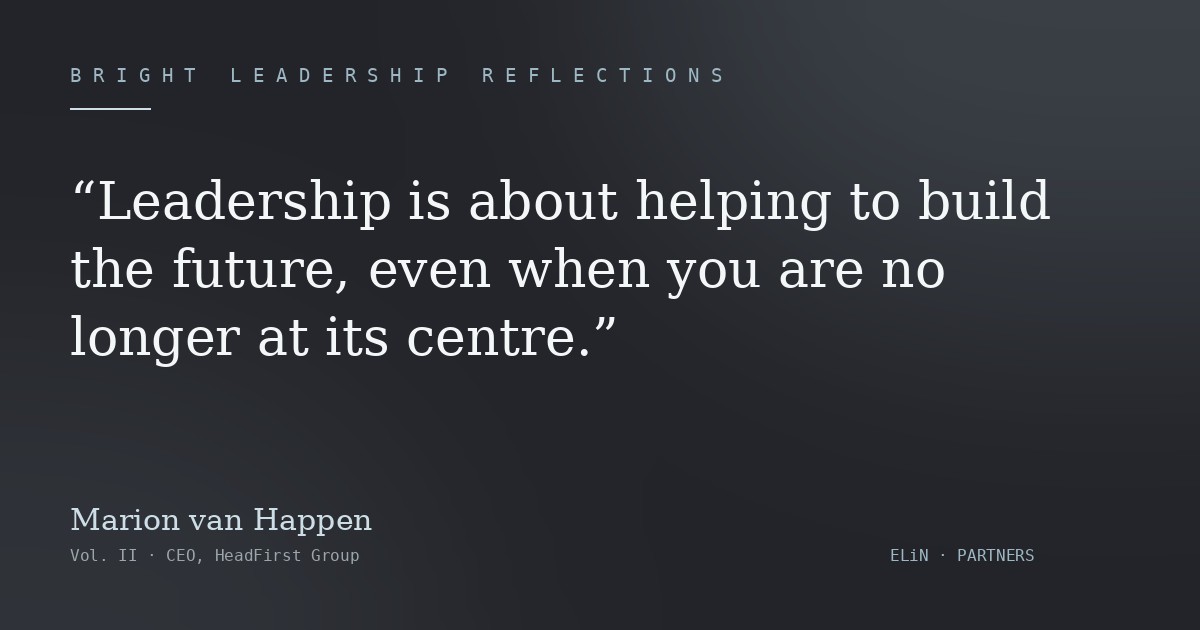
Leadership is about helping to build the future, even when you are no longer at its centre.